Archive and research
Books on learning: practical choices and research reading
This list favours research syntheses, durable primary work and useful historical context. An inclusion is not a blanket endorsement. Each note says what the work contributes and where age, scope or evidence should limit its use. The book choices are assessed for reader fit alongside research and historical reading. Publisher records and educational resources are ordinary reference links. I recommend checking a library or a free preview before buying.

Key takeaways
- Begin with reviews before isolated studies.
- Check whether evidence matches your age group, subject and setting.
- Read influential older works historically as well as practically.
- Separate a compelling framework from proof of an outcome.
Choose a book for the task you actually have
These three choices serve different readers: a general student, a maths or science learner, and an educator designing teaching. This is a desk-researched selection using publisher descriptions, edition records and research-linked resources, not a claim that the publisher has read or tested each whole book. We do not rank them as universally best.
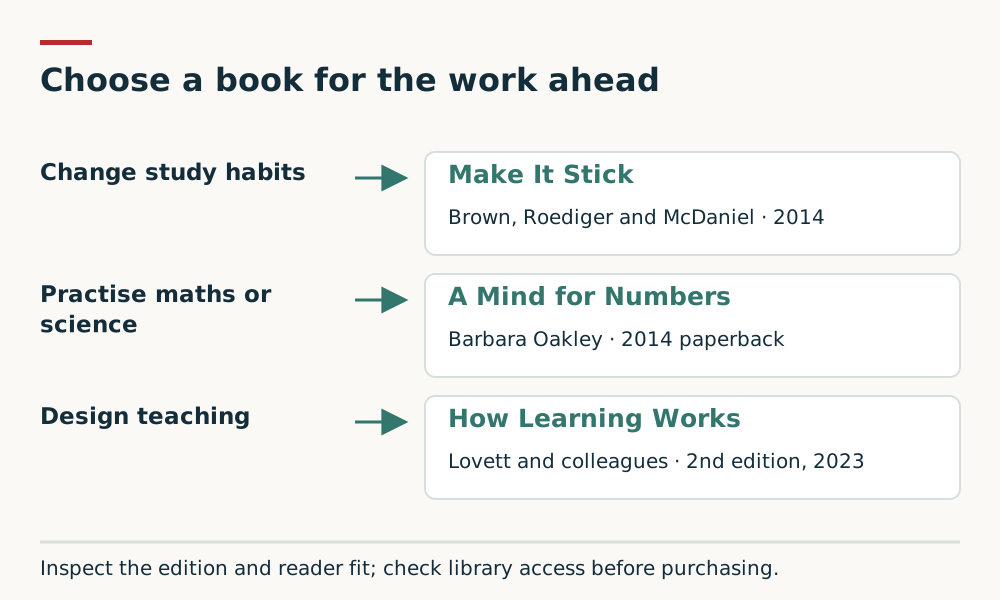
Check a sample or borrow first. The Penguin Random House record offers a sample and lists print, ebook and audio formats; Wiley lists a sample chapter for the second edition of How Learning Works. Library holdings, digital lending and local stock vary. Ask your library to search by title, author and the edition below before buying.
| Book and edition | Useful for | Why consider it | Limit or access check |
|---|---|---|---|
| Make It Stick: The Science of Successful Learning. Peter C. Brown, Henry L. Roediger III and Mark A. McDaniel, 2014 first edition, Harvard University Press. | Students and adult learners changing study habits. | An accessible starting point for retrieval and spaced practice; pair one idea with a concrete study routine. | The selection draws on the research team’s chapter resources and a Harvard bibliography; the publisher preview was unavailable during this review. Ask a library for the 2014 edition. |
| A Mind for Numbers. Barbara Oakley, 2014 paperback, Tarcher/Penguin. ISBN 9780399165245. | Maths and science learners who need a more deliberate practice routine. | A subject-oriented way to think about practice, difficult problems and taking breaks. | Its explanatory metaphors should not be treated as proof of every neuroscience claim. Preview through the publisher and check library access before buying. |
| How Learning Works: Eight Research-Based Principles for Smart Teaching. Marsha C. Lovett and colleagues, second edition, 2023, Wiley. ISBN 9781119861690. | Educators and course designers, especially in higher education. | Connects learning principles with teaching decisions; a stronger fit for designing feedback and learning conditions than a quick student tips list. | This edition has eight principles; the earlier edition has seven. Use the publisher sample to judge fit and ask an institutional library about print or ebook access. |
My starting choices for three different readers
For a general learner changing study habits, my starting choice is Make It Stick: its retrieval and spacing focus connects directly with a routine you can try. For a learner struggling with maths or science practice, I would inspect A Mind for Numbers first. For an educator designing feedback and learning conditions, How Learning Works is the more relevant starting point. These are judgments of fit from the available descriptions and research resources, not claims that one book produced better results in a reading trial.
For no-cost action today, use the memory guide and its original practice schedule, or the freely accessible research resources linked below. A library copy is preferable to buying several books before applying one useful idea. Do not judge learning value by page count or the number of principles on a cover.
Penguin Random House’s record lists the 2014 paperback at 336 pages and US$20 when checked on 23 September 2026. That is one publisher’s listed price for one format, not a UK delivered-price comparison. Its audiobook is listed at 7 hours 5 minutes; listening duration excludes your own practice and review.
How to use a recommendation critically
Pick one book whose audience matches your situation. Before each chapter, write the problem you want it to help solve. Afterwards, explain one claim, find its supporting evidence and test a small change in your own study or teaching. A readable story can motivate a change without proving that it works everywhere.
Use the textbook note workflow to keep a claim, its limitation and its source location together.
The research reading below remains the basis for evaluating learning claims. A book is a route into those ideas, not a replacement for checking the population, task and outcome in the underlying evidence.
Evidence-based study and memory
- Dunlosky et al. (2013), Improving Students’ Learning With Effective Learning Techniques. A broad review of ten study methods; influential and still useful, but classroom implementation depends on subject and context.
- Pashler et al. (2008), Learning Styles: Concepts and Evidence. Defines the experimental evidence needed for matching and explains why preference does not validate a prescription.
- EEF (2021), Cognitive Science Approaches in the Classroom. A school-focused evidence review that is explicit about limits in natural classroom settings.
Teaching and instructional design
- Sweller, van Merriënboer and Paas (2019), Cognitive Architecture and Instructional Design. A modern review of cognitive load theory; useful when design decisions remain tied to learner knowledge and the actual task.
- Roediger and Karpicke (2006), Test-Enhanced Learning. A primary study on retrieval and delayed retention; read alongside later syntheses rather than as a complete teaching policy.
Digital learning
- Means et al. (2010), Evaluation of Evidence-Based Practices in Online Learning. A major US Department of Education meta-analysis; valuable but dated and frequently overgeneralised.
- Edisherashvili et al. (2022), Supporting Self-Regulated Learning in Distance Learning Contexts. A systematic review that maps support across planning, performance and appraisal.
Organisational learning
- Edmondson (1999), Psychological Safety and Learning Behavior in Work Teams. Foundational field research linking team climate, learning behaviour and performance; one study is a foundation, not a universal maturity model.
- Wenger (1998), Communities of Practice. Influential social theory of learning and participation; useful as a lens, but not a turnkey programme.
Historical context
- Dryden and Vos, The Learning Revolution (1993 and later editions). Important to this domain’s history and turn-of-the-century education optimism. Read its claims in the context of the evidence available at the time.
- O’Brien (1990), Construct Validation of the Gregorc Style Delineator. A short empirical check that found psychometric weaknesses in a widely circulated framework.
Sources and further reading
- RetrievalPractice.org: Make It Stick chapter resources (accessed 23 September 2026)
- Harvard Derek Bok Center: teaching handbook bibliography, Make It Stick (2014 first edition) (accessed 9 September 2026)
- Penguin Random House: A Mind for Numbers, 2014 paperback (accessed 23 September 2026)
- Wiley-VCH: How Learning Works, second edition (2023) (accessed 23 September 2026)
- Dunlosky et al. (2013) (accessed 23 September 2026)
- Pashler et al. (2008) (accessed 23 September 2026)
- EEF cognitive science review (2021) (accessed 23 September 2026)
- Means et al. (2010): revised US Department of Education online-learning report (accessed 23 September 2026)
- Edmondson (1999) (accessed 7 September 2026)
- WorldCat record for The Learning Revolution (1993) (accessed 23 September 2026)
Access dates are recorded beside each source. Please report a source or factual concern.