Reading and research
Google Scholar alternatives: choose the tool for the research task

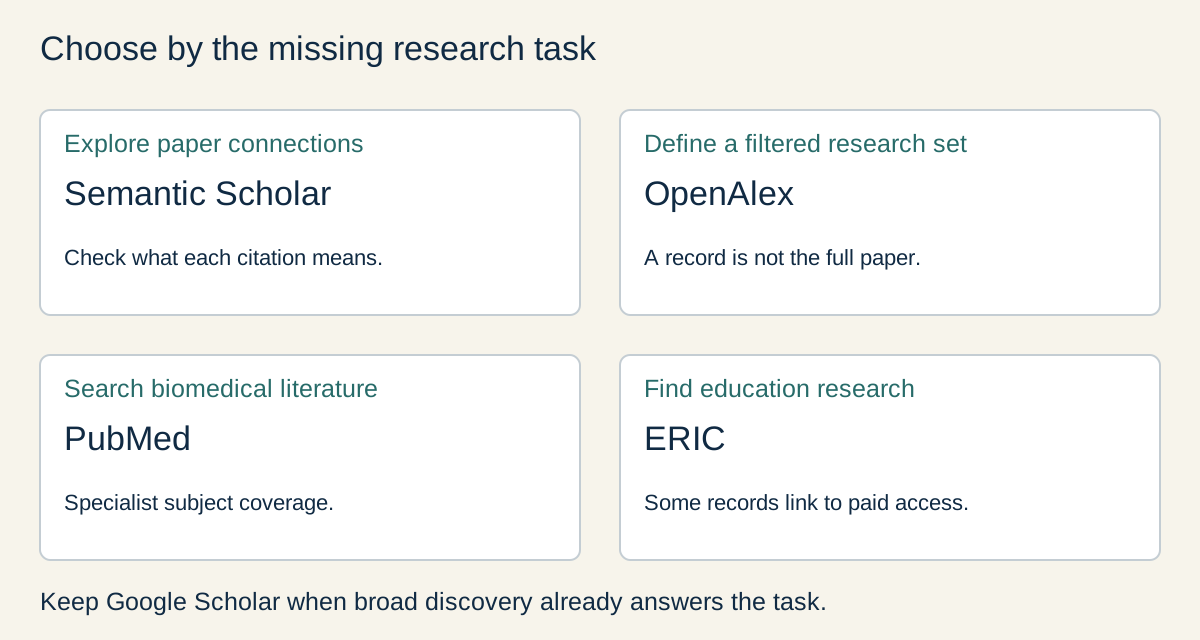
My starting choice is Semantic Scholar for exploring connections between papers, OpenAlex for a filterable research set, PubMed for biomedical literature, and ERIC for education research. Keep Google Scholar for broad discovery when it already finds what you need. Use a second tool to solve a specific gap, then check the original paper: a search result, citation count or free record does not guarantee a relevant, reliable or freely readable article.
The shortlist: four tools for different research jobs
I would add a tool when it answers a question your current search cannot answer. Are you missing related work, trying to define a reproducible set, searching a specialist subject, or simply trying to read a paper you already identified? Those are different jobs. Moving the same vague query between five websites can create more tabs without improving the evidence.
The order below follows those jobs, rather than measured search quality. Compare subject fit, search controls, access and what you can save. The worked example checks real publisher and university-repository records; it is not a timed comparison of the search engines or a test of their complete coverage.
- Semantic Scholar: explore paper connections
- OpenAlex: build a filterable research set
- PubMed: search biomedical literature
- ERIC: find education research
| Option | Useful starting task | Access or saving route | Main limitation |
|---|---|---|---|
| Semantic Scholar | Find connected scientific papers | Free discovery; citation tools and an account-based library | Its web search does not support Boolean operators or wildcards. |
| OpenAlex | Define and inspect a filtered set of works | Basic website search is free without an account; documented exports | A metadata record is not the full paper; basic mode has query limits. |
| PubMed | Find biomedical and life-science literature | Search fields, subject vocabulary and citation-manager export | It is a specialist index, not a universal academic search. |
| ERIC | Find journal and non-journal education literature | Public education-research records; some linked or hosted full text | A record may lead to a purchase page rather than a free article. |
1. Semantic Scholar: for exploring connected papers
Semantic Scholar is my first alternative for moving from one useful scientific paper to a wider reading list. Start with a title or a focused topic, inspect the paper record and follow references and citing papers. Treat those connections as leads: a later paper may disagree with the earlier one, use only its method, or mention it as background.
Its official FAQ describes free discovery, citation formats and a library for saving and organising papers. It supports quoted text but not Boolean operators or wildcards in the web search. Do not paste a complex AND/OR strategy from another database and assume it means the same thing here.
For a small reading list, open the source behind each record before saving its citation. Check author names and dates, and keep a note of why the paper belongs in your assignment. Choose this route for discovery; use a specialist database when your question needs controlled vocabulary or precise field-based searching.
2. OpenAlex: for a filterable set of research records
OpenAlex is useful when you need to explain how a set of works was selected. Its basic website search works without an account or charge, with filters such as year, work type, open-access status and institution. Record the query and filters before changing them, so a reader can understand the boundary of your set.
The basic-search guide explains the searchable fields, filtering and facets. Its simpler controls do not express every complex query; the advanced builder is the next step when the basic interface cannot represent the question.
The export documentation lists CSV, RIS and text formats for works. A table of records and a reference-manager file serve different purposes. Keep the original export before shortening fields for a spreadsheet, because shortening can discard information.
I would use it to inspect a defined set, not to call the most-cited result the best evidence. Older work has had more time to collect citations, and subject areas differ. Check the actual article, its version and the reason it is being cited. Basic search access also says nothing about the price or conditions of separate APIs, bulk services or advanced products.
3. PubMed: for biomedical and life-science questions
PubMed is the specialist option here when your topic belongs in biomedical or life-science literature. A broad phrase can be a starting point, but a careful search may need fields, synonyms and subject vocabulary. It is not the natural first stop for every humanities or business assignment.
The PubMed user guide documents Boolean operators, field tags, MeSH subject searching and citation-manager export in .nbib format. It also explains full-text links and filters. A citation record is different from a hosted article, and not every record has a free full-text copy.
For an assessed literature review, save the exact query and date, then record each filter. Check how a subject term is being mapped before relying on it. A free-full-text filter can help when access is the immediate problem, but it also changes the evidence set; it should not silently become a quality criterion.
4. ERIC: for education research and reports
ERIC is worth adding when the question concerns teaching, learning or education policy. Its focus includes journal and non-journal literature, so it can lead you to reports and other material that a journal-only search would miss. That breadth makes identifying the document type especially useful.
The Institute of Education Sciences description of ERIC explains its education remit and bibliographic records. Some full texts are available without charge, while other records link to a publisher or purchase route. Check the destination instead of treating every ERIC result as a free PDF.
Use the abstract and record details to decide whether a source answers your question, then read its methods and limitations. A policy paper, conference report and controlled study can contribute different things. Do not merge them into one evidence category simply because the search engine returned them together.
When keeping Google Scholar is the sensible choice
Google Scholar’s own search help describes broad scholarly discovery, related work, versions, library access and citation export. If it locates the paper you need and its source is traceable, switching tools may add little.
I would keep the useful search and add a specialist route for a named gap. For example, broad discovery can establish the vocabulary, while an education index can help find a report. A university library may also provide licensed databases or the full article through an existing subscription. Check that access before paying personally.
No search engine is a complete quality filter. An indexed article may be irrelevant to your population, a preprint may differ from the published version, and a highly cited work may be cited critically. Discovery gets you to a source; reading and appraisal decide what you can use.
A worked record check: one paper, two records
Suppose an assignment asks what evidence would be needed to support matching teaching to a learner’s preferred style. The review Learning Styles: Concepts and Evidence is a useful starting record. Use its exact title and DOI, 10.1111/j.1539-6053.2009.01038.x, to distinguish it from similarly titled discussions.
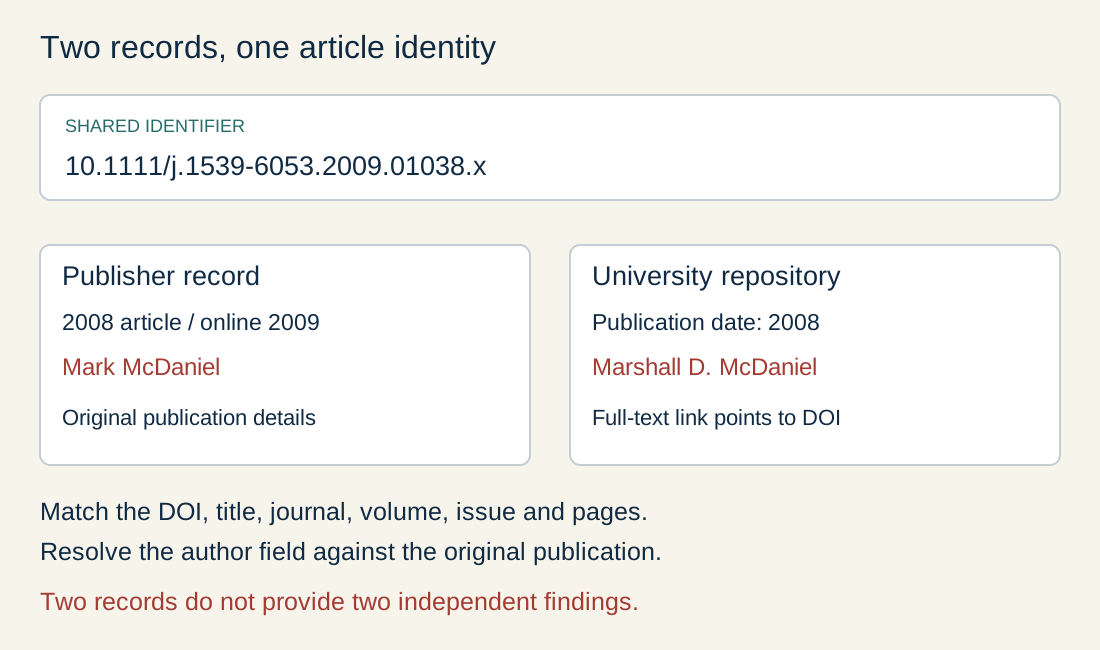
The publisher record identifies Pashler, Mark McDaniel, Rohrer and Bjork, volume 9, issue 3. It labels the article as 2008 and separately gives an online publication date of 1 December 2009. Preserve that distinction rather than assuming the later date identifies a new study.
The University of South Florida repository entry uses the same DOI and title and lists the journal, volume, issue and pages 105–119. It gives 2008 as the publication date, but its McDaniel name differs from the publisher’s. Use the original publisher record to resolve the author field before submitting the citation.
The repository’s full-text link points to the DOI. Finding the repository entry therefore does not by itself establish that it hosts a separate downloadable manuscript. Follow the link, identify what you can actually read and record the version. These are two records of one article, not two independent pieces of evidence.
For the assignment, the next step is to read the review’s account of the evidence required, then look for relevant later work. Do not turn a paper-discovery exercise into a claim that people are fixed learner types. Our learning-styles guide covers the substantive evidence; this example concerns identifying and checking the source.
| Field | What this example shows | Your next check |
|---|---|---|
| Identity | Same title and DOI across publisher and repository | Match journal, volume, issue and pages too. |
| Date | 2008 article label; 1 December 2009 online date | Use the date required for the cited version and style. |
| Author | Repository and publisher differ on McDaniel’s name | Confirm the original publication before exporting a final citation. |
| Access | Repository link leads onward to the DOI | Check the actual full text and version, not only the record. |
Keep a small search log you can reuse
Download the editable research search log (.txt). It includes a blank record and the completed publisher/repository example above. The filled section records identity checks, not a claim that the same live search was run in all four tools.
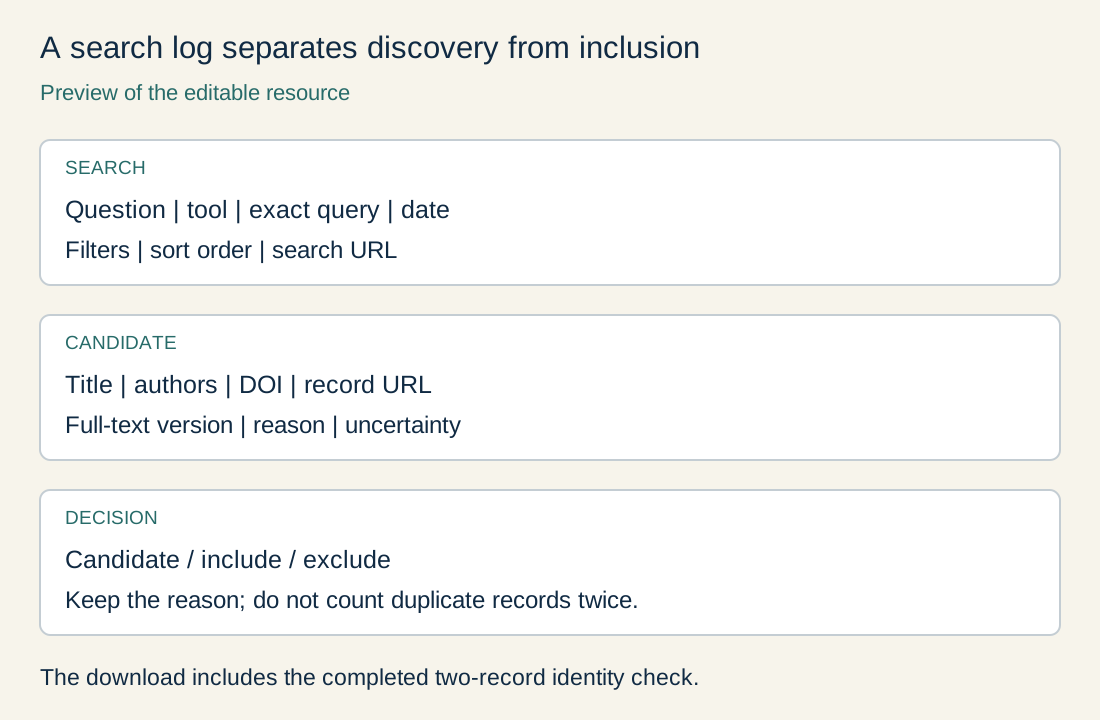
Write the research question, tool, exact query, date and filters. For each promising item, save the title, DOI or stable identifier, record URL, full-text location, version and a one-sentence inclusion reason. Add a separate note for uncertainties such as an author-name mismatch.
Keep candidates and included papers separate. A useful abstract is a reason to inspect a source, not enough to quote a result you have not read. When you remove a paper, preserve a short reason such as wrong population, duplicate record or no usable account of the relevant method.
For a larger or systematic review, follow the required protocol and obtain subject-librarian or methods support. This compact log is for a manageable study task; it does not establish a comprehensive search, reproducible database coverage or compliance with a review-reporting standard.
Final verdict: add the tool that fills your actual gap
Choose Semantic Scholar for exploring connections, OpenAlex for defining a filtered set, PubMed for biomedical searching, or ERIC for education literature. Keep Google Scholar when broad discovery is already working. There is no universal winner across these different tasks.
My practical stopping point is a traceable source you can read, a checked citation and a clear reason it belongs in your work. Once you have that, spend the next session reading the paper rather than collecting another page of search results.
Sources and image credits
- Semantic Scholar: official FAQ and search limits (accessed 15 November 2026)
- OpenAlex: Basic website search (updated 3 October 2026) (accessed 15 November 2026)
- OpenAlex: works export formats (accessed 15 November 2026)
- PubMed: User Guide (updated 30 September 2026) (accessed 15 November 2026)
- Institute of Education Sciences: ERIC remit and access (accessed 15 November 2026)
- Google Scholar: Search Help (accessed 15 November 2026)
- Pashler et al.: publisher record (accessed 15 November 2026)
- University of South Florida: record for the same DOI (accessed 15 November 2026)
Access dates are recorded beside each source. Please report a source or factual concern.