Reading and research
How to evaluate online sources before you use their claims

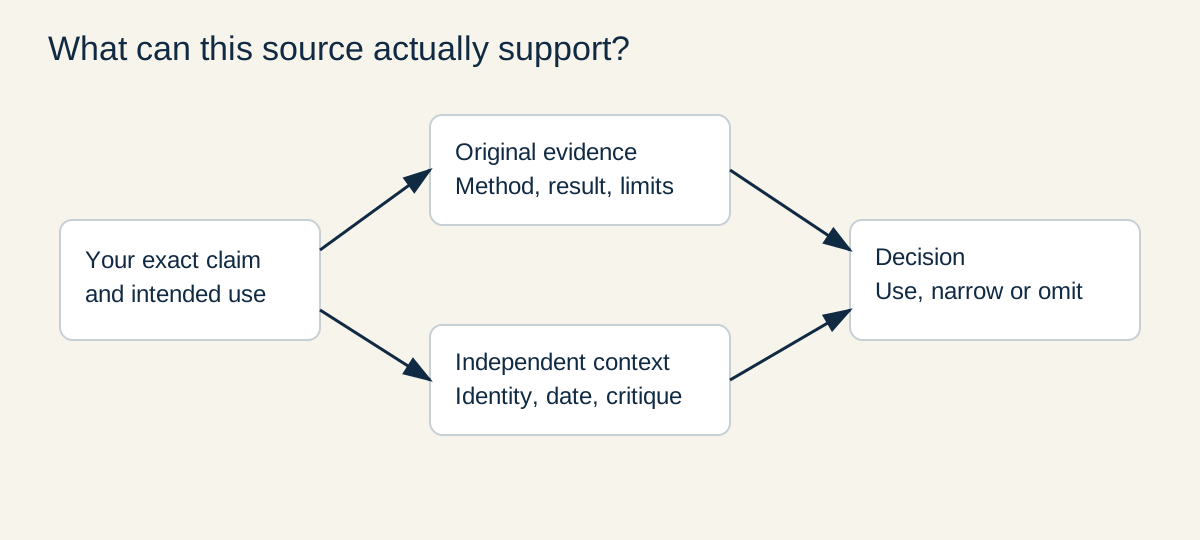
Start with the exact claim you need to support. Check who produced it, follow its evidence to the original source, and look outside the website for independent context. Match the evidence to your question, date and population. Then decide whether to use it, narrow the claim, find a stronger source or leave it out. A polished website, a citation or several repeating articles does not settle those checks.
Choose the claim before judging the whole website
I would begin with one sentence from the assignment or decision: what do I need to know, and what kind of evidence would answer it? “Does this app offer offline access?” and “Does this app improve exam results?” require different sources. The first may be answered by current product documentation; the second needs evidence about learning outcomes.
Save the claim, the page title, author or organisation, URL, publication or update date and the date you accessed it. For a changing product claim, add the plan, operating system and version if they matter. A useful source check ends with a traceable decision, rather than a vague impression that a site looks trustworthy.
A source can be suitable for one purpose and unsuitable for another. A seller can accurately describe its subscription terms while overstating what a study proves. A personal account can illustrate a learner’s experience without establishing what most learners should expect. Evaluate the proposed use, not just the publisher’s overall reputation.
Leave an unfamiliar site to check who is behind it
The Digital Inquiry Group calls this lateral reading: look beyond a page’s self-description and check what other sources say about its publisher and claims. Its teaching materials contrast this with staying inside one website.
Open a separate search for the organisation and author. Look for relevant expertise, a verifiable institutional connection, funding and an explanation of what the publisher does. Distinguish an organisation’s own About page from independent reporting about it. A job title, logo or impressive biography needs context; expertise in one area does not establish expertise in every subject.
Look for accountability: a named publisher, contact details, a corrections policy and a way to identify the original work. These help you investigate a source; they do not prove its claim. A commercial interest is a reason to inspect the evidence and selection of facts, rather than an automatic reason to reject every statement.
The University of Texas at Austin’s source-evaluation guide also stresses that professional appearance and search position are weak substitutes for checking a source. Its evaluation criteria depend on the information you actually need.
Follow the claim upstream to the original evidence
Open the reference beside the claim. Does it lead to the actual study, dataset, policy, interview or product documentation, or just to another article? Continue until you can identify who produced the underlying evidence. Save the exact section, table or passage that supports the statement.
Read enough surrounding material to check whether the summary has changed the meaning. Check what was measured, who was included, the comparison used and the time period. A confidence survey is not an attainment test. An association is not automatically a causal result. A finding about one task is not a guarantee about a whole course.
If access stops at an abstract, record that boundary. Try a legitimate author manuscript, repository or library route. Do not claim to have checked a full paper you could not read. If the necessary method or limitation is unavailable, use a different accessible source or make a narrower statement that the available material supports.
Worked example: a fictional learning-app claim
All organisations, documents and results in this exercise are fictional. They are practice material, not a report about a real app or evidence for purchasing one.
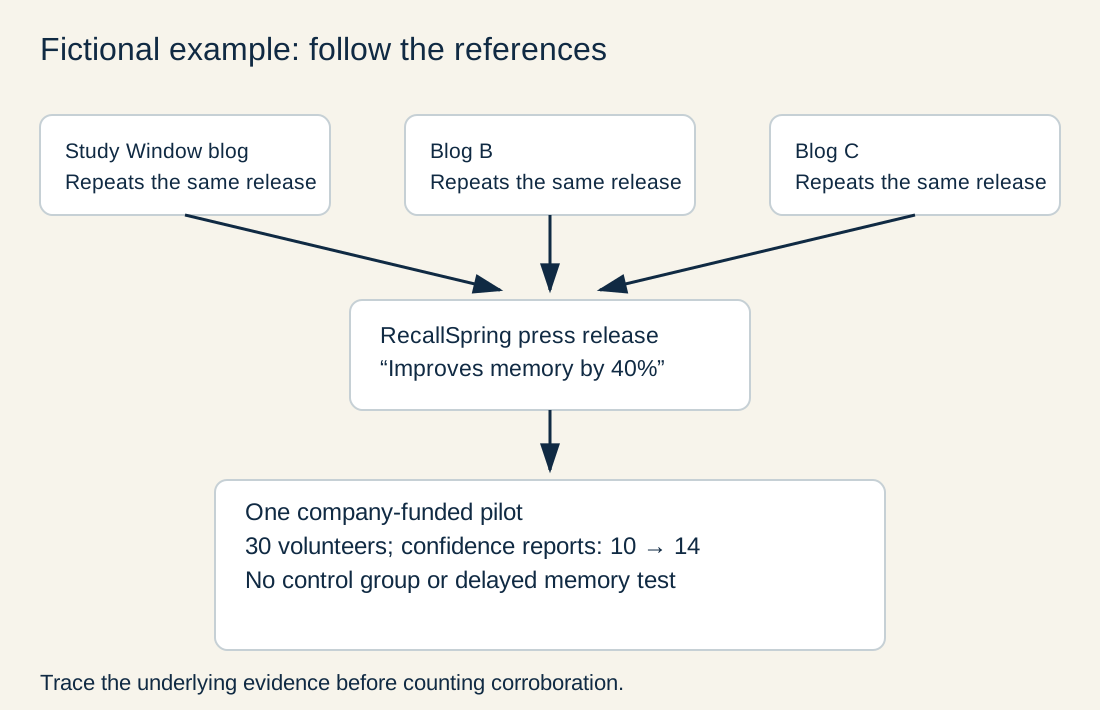
Your assignment asks whether a digital flashcard app improves long-term retention. A fictional blog called Study Window says: “RecallSpring improves memory by 40%.” Its link leads to a RecallSpring press release, which cites a company-funded pilot report. Two other blogs repeat the same press release.
In the fictional report, 30 volunteers used the app for one revision session. Before using it, 10 said they felt confident about the topic; afterwards, 14 did. There was no control group, knowledge test or delayed assessment. The calculation (14 − 10) ÷ 10 = 40% describes the relative increase in people reporting confidence. The confidence share rose from 33.3% to 46.7%, a change of about 13.3 percentage points.
That is not a measured 40% improvement in memory. It also does not show that the app caused the confidence change. The three blogs do not provide three independent findings: they lead back to one company report. Funding is relevant context, but the decisive problem here is the mismatch between the advertised claim and the measured outcome.
For the assignment, I would exclude this source as evidence of improved long-term retention. I could use it, with attribution and limits, as an example of how a company describes a pilot. To answer the learning question, I would seek a relevant retention study with an appropriate comparison and a delayed measure. I would not turn the lack of adequate evidence in this exercise into a claim that the app cannot help anyone.
| Check | What the practice material shows | Decision |
|---|---|---|
| Original source | One company-funded pilot; blogs repeat its release. | One evidence source, not independent corroboration. |
| Measured outcome | Self-reported confidence immediately after one session. | Do not relabel this as memory or exam performance. |
| Comparison and timing | No control group or delayed assessment. | Does not answer the long-term retention question. |
| Appropriate use | A company’s description of its own pilot. | Possible attributed example; unsuitable proof of effectiveness. |
Check whether agreement is independent
Compare the sources behind apparently matching articles. Shared wording, the same quotation and identical numbers can reveal a common press release. Trace the references before treating repetition as corroboration. Different publishers can still depend on the same dataset or interview.
Independent sources are useful when they bring separate evidence or a reasoned examination of the original. A later correction, replication, systematic review or specialist critique may change your interpretation. An alternative source need not reach the opposite conclusion to be independent.
When sources disagree, compare their questions, dates and definitions before deciding which is stronger. An old interface guide and current documentation may both accurately describe different software versions. Two studies may measure different outcomes. Record the reason for the disagreement rather than choosing the answer you wanted.
Use date, expertise and purpose in context
The House of Commons Library’s guide to evaluating sources brings together authority, relevance, transparency, purpose and accuracy. These are prompts for investigation, not a numerical credibility score.
For current app prices or export instructions, an old page can be materially wrong even if its author is knowledgeable. For a historical account, an original contemporary document may be exactly what you need. Check whether an Updated date reflects a relevant change; it does not establish that every statement has been reviewed.
A .edu, .ac.uk or .gov address can help identify a publisher, but the domain alone does not establish that a particular statement is correct or current. Peer review adds scrutiny without guaranteeing correctness. A detailed methods section helps you examine a study; it does not remove the need to read its limitations.
For health, legal, financial or other consequential decisions, raise the standard and seek current specialist or official guidance. This worksheet helps organise questions; it is not a substitute for the expertise needed to assess a technical claim.
Download a source-evaluation worksheet
Download the editable source-check worksheet (.txt). It contains blank fields and a completed version of the fictional app exercise. Open it locally or copy it into a document. It requires no account or personal information.
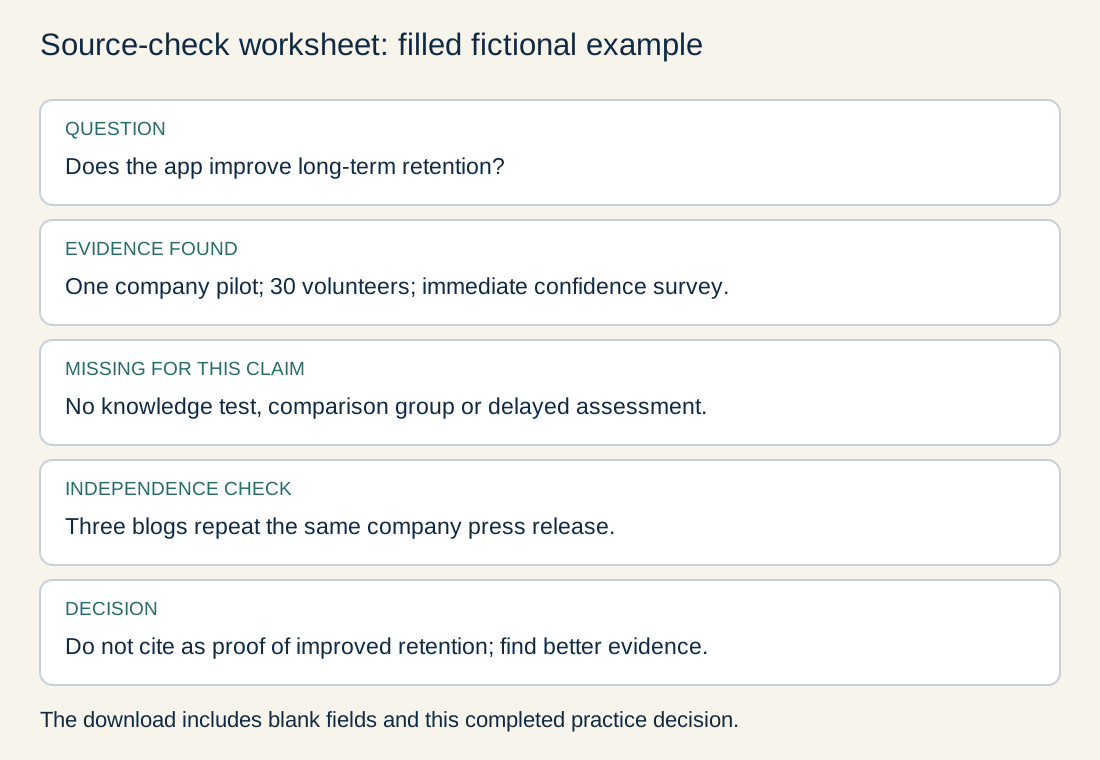
Write a short decision explaining what this source supports, what it does not support and which check remains unresolved. Keep the evidence location with the note so you can revisit it. You do not need to submit the working worksheet unless the assignment asks for it.
If you use an AI summary to find possible leads, open and check the cited material yourself. A fluent answer or plausible reference is not evidence that the source exists or supports the claim. Follow your institution’s rules, and do not upload confidential or restricted material without permission.
Next steps: make the source earn its place
Use a source when its evidence supports the particular statement you plan to make. Narrow a claim when the source supports less than the headline promises. Find a stronger source when the missing information is essential; leave a claim out when you cannot substantiate it. Record uncertainty instead of filling the gap with confidence.
Once you have selected a research paper, examine its question, method, result and limits before drafting from it. The reading guide below takes you through that next task. Keep your evaluation notes beside the source, then use the summary and editing guides when you turn those notes into your own work.
Sources and image credits
- Digital Inquiry Group: Teaching Lateral Reading (accessed 1 November 2026)
- University of Texas at Austin Libraries: Evaluation through Lateral Reading (accessed 1 November 2026)
- House of Commons Library: How to evaluate sources (5 May 2026) (accessed 1 November 2026)
Access dates are recorded beside each source. Please report a source or factual concern.