Reading and research
How to summarise an academic article without losing its meaning
Identify the article’s question or argument, select the evidence needed to explain it, and write a shorter account in your own words with attribution. Keep the main finding and its important limits together. Check every sentence against the full article before submitting; an abstract or an AI-generated account is a starting point for checking, not a substitute for the source.

Key takeaways
- Summarise this article, rather than writing a general introduction to its topic.
- Choose details by the assignment and the claim, not by copying one sentence per paragraph.
- Keep a private source location beside each important statement.
- Shorten background before removing a qualification that changes the finding.
Start with the output you have been asked to produce
I would put the assignment beside the article before opening a blank document. Note the word limit, audience, required citation style and whether you need a neutral summary, a critical response or a summary followed by evaluation. Those are different outputs. Your assignment instructions take priority over a generic template.
Trent University’s article-summary guidance distinguishes explaining a specific article from discussing its general subject. That is the useful starting boundary: a summary should let someone understand what this author investigated or argued and how the article supports its main point.
An abstract is the authors’ compressed presentation of their work. An assignment summary is your account for a particular reader and purpose. Copying or lightly rewriting the abstract leaves you dependent on its selection of details and may miss a limitation explained later in the paper.
If you cannot yet explain the study, use the research-paper reading guide first. This page begins with understood source notes and concentrates on turning them into a finished summary.
Build a small source map before writing
Record the title, authors, year and DOI or stable URL, then collect the few details that carry the article’s meaning. Beside each, save a page, section, figure or table location. The map is a working aid; you do not have to submit it unless your tutor asks for it.
For an empirical study, look for the question, design, participants or material, important finding and the boundary of that finding. For an argumentative article, record the thesis, main reasons, evidence and an important qualification. For a review, identify how the literature was selected, its scope and the synthesis; do not describe it as a single experiment.
Do not copy every source sentence into the map. A short note such as “Table 2: quiz score, not course grade” may be enough to prevent a later mistake. Keep any copied wording in quotation marks from the moment you record it.
| Role in the summary | Source location | Detail to retain |
|---|---|---|
| Question | Section A | Does shared annotation change performance on a short source-comparison task? |
| Design | Section B | 48 students; random allocation; two groups of 24; the same texts and 20 minutes. |
| Finding | Section C | Mean immediate scores of 8.5 and 7.0 out of 12; no uncertainty estimates supplied. |
| Boundary | Section D | One seminar and an immediate task; no later assessment or course-grade measure. |
Worked source: a fictional shared-annotation report
Everything in this report is fictional, including the authors, article title, students and results. It is a compact practice source, not a real study or evidence for buying an annotation tool. The section letters are stable locations you can use in the worksheet.
A. Purpose. Lin and Ahmed’s fictional 2026 report, “Shared annotations in an online history seminar”, asks whether discussing annotations helps students compare two historical sources. It examines an immediate task, rather than long-term learning.
B. Method. Forty-eight students in one seminar are randomly allocated to two groups of 24. Both groups receive the same two texts and 20 minutes. One group can see and discuss shared annotations in a digital document; the other writes individual notes in the same document environment. Everyone then completes the same individual 12-point source-comparison task without access to the notes.
C. Result. The report gives mean scores of 8.5 out of 12 for the shared-annotation group and 7.0 for the individual-note group. It does not supply score distributions, confidence intervals or a significance test. The authors suggest that discussing interpretations may help explain the difference, but they did not measure that mechanism separately.
D. Scope. The report covers one seminar and one immediate task. It provides no later assessment, course grades or evidence about other subjects. It also does not separate the effects of discussion from those of viewing other people’s annotations.
Turn the map into a connected summary
For this exercise, imagine a tutor asks for one short paragraph explaining the study and its limits. I would write the draft below from the map, then reopen sections A–D to check it. The names and citation are fictional practice details; do not put this example in a real bibliography.
In their fictional report “Shared annotations in an online history seminar”, Lin and Ahmed (2026) examine an immediate source-comparison task. Forty-eight students were randomly allocated to shared annotation with discussion or individual notes, using the same texts and study time. The shared-annotation group averaged 8.5 out of 12, compared with 7.0 in the individual-note group. However, the report supplies no uncertainty estimates and measures neither later performance nor course grades. It also does not isolate discussion from access to peers’ annotations. The result therefore describes a higher mean on one immediate task; it does not establish a lasting learning benefit or identify which part of the activity produced the difference.
The paragraph identifies the source, explains enough method to interpret the result and retains the qualifications. It does not repeat every detail in the report. In a real assignment, supply the full reference in the requested style and include pinpoint locations where that style or your task requires them.
Keep reporting verbs precise. “Report” describes a stated result; “suggest” can introduce the authors’ interpretation. Avoid “prove” when the evidence does not justify it. If the article presents uncertainty you do not understand, resolve that point before deciding what the result means.
Shorten by changing detail, not the strength of the claim
For a much shorter note, retain attribution, the central comparison and the strongest relevant boundary. Here is a compact version of the same fictional report:
Lin and Ahmed’s fictional study (2026) reports a higher mean immediate source-comparison score after shared annotation with discussion than after individual notes. It covers one seminar, supplies no uncertainty estimates and measures no later learning. Discussion and shared annotations were not evaluated separately.
For a longer assignment summary, expand the rationale, design and interpretation with source-supported details. Do not pad it with general history of annotation software. A fixed percentage of the original article is less useful than the actual brief and the information needed to understand the claim.
If you must cut another sentence, ask what misunderstanding the remaining version could create. Removing a repeated topic sentence is usually less damaging than removing “immediate”, changing “mean score” to “learning”, or losing an essential population boundary.
| Tempting wording | Problem | More accurate choice |
|---|---|---|
| The app improved grades by 21%. | Changes the outcome, adds a product claim and conceals the study’s limits. | Report the two immediate task means on their original 12-point scale. |
| The study found no difference. | Lack of uncertainty estimates does not establish no difference. | The means differ; the report does not provide enough information to assess uncertainty. |
| Collaboration caused the result. | The example did not isolate discussion from viewing shared notes. | Name the combined activity and retain the unresolved explanation. |
| Annotation works for students. | Generalises beyond one seminar and one measured task. | State the studied setting and the immediate outcome. |
Use your own wording and make the source visible
Purdue OWL distinguishes summary, paraphrase and quotation: a summary compresses the main ideas, while a paraphrase restates a particular passage in your own wording. Both need attribution. Exact borrowed wording needs quotation treatment and the required citation.
After drafting from your notes, compare the wording and sentence structure with the source. Keeping the original sentence pattern while swapping a few synonyms is a poor route to an independent account. Retain necessary technical terms, but make sure you can explain them.
Use the student editing checklist for a worked paraphrase and a final reference check. In a longer summary, make it clear when you are still reporting the same article; a citation at the end of several ambiguous paragraphs may leave the reader unsure whose claim they are reading.
Keep summary and your evaluation distinguishable
The UNC Writing Center’s guidance on using summary explains why the balance between reporting a source and analysing it depends on the writing task. A literature-review paragraph needs to connect sources to your argument; a standalone summary has a different job.
For our fictional report, “The authors suggest discussion may explain the difference” reports their interpretation. “I would want a delayed task and a separate discussion-only condition before recommending the workflow” is an evaluation. Label or position those functions as the assignment requires; do not present your proposed next study as a result of this one.
A limitation can belong in a neutral summary when it defines the finding. That is different from adding an unsupported verdict that the entire article is worthless. For a theoretical paper, preserve the conditions of the argument rather than inventing the sample or test it never had.
Download the editable article-summary worksheet
Download the article-summary worksheet (.txt). It includes a blank source map, drafting prompts, the fictional report and both sample summaries. Open it locally or copy it into an approved document; no account is required.
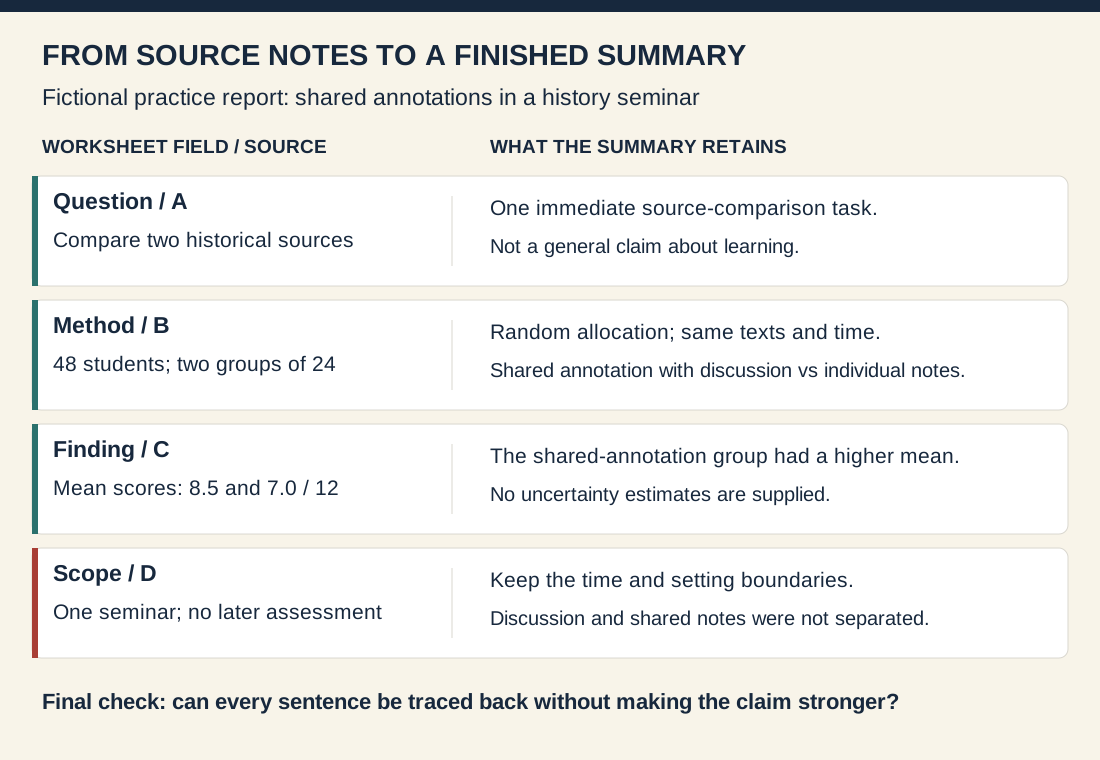
The filled preview above shows the same fields used in the download. Keep the full source and your private map together while revising. Remove working notes from the submitted document unless they are requested, but retain them so you can check a claim later.
If you use an AI tool, follow your institution’s rules and the source’s access conditions. Do not upload confidential, unpublished or restricted material without permission. Check every proposed statement, number and reference against the original; fluent wording does not establish accuracy. Record and disclose permitted assistance where your assignment requires it.
Finish with a sentence-by-sentence accuracy check
Read the summary once without the original. Does it explain this article clearly to the intended reader? Then reopen the source and check the population, method, outcome, numbers, attribution and each qualification. A useful final question is: could a reader infer something stronger than the article supports?
Check the assignment limit and reference format last. If your summary is accurate but too long, return to the selection of detail. If it is short but misleading, restore the missing distinction before polishing the prose.
- Every important statement has a source location in my working map.
- Numbers retain their units, denominators and measurement timing.
- Authors’ claims, reported results and my evaluation are distinguishable.
- No invented method, causal explanation, citation or product benefit has appeared.
- The final document follows the actual assignment and permitted-tool rules.
Sources and further reading
- Trent University Academic Skills: Writing Article Summaries (accessed 19 October 2026)
- Purdue OWL: Quoting, Paraphrasing, and Summarizing (accessed 19 October 2026)
- UNC Writing Center: Summary: Using it Wisely (accessed 19 October 2026)
Access dates are recorded beside each source. Please report a source or factual concern.