Learn better
An editing checklist for students: improve the argument first
Start with the assignment question and your argument, then check evidence, paragraph order, sentence clarity and references. Proofread last. I would rather fix a weak explanation than polish a paragraph that does not belong in the assignment.

Key takeaways
- Use the assessment brief as your first checklist.
- Separate what a source measured from what you infer.
- Keep a record of meaningful changes.
- A grammar correction or readability score cannot validate an argument.
How to use the checklist
This is an original editing workflow and worked example, informed by university writing guidance. It is a teaching resource, not a claim that following it guarantees a particular grade. I recommend working on a saved copy so you can compare the original argument with the revision.
If time is short, prioritise the brief, the central claim and the evidence supporting it. A missing answer to the question matters more than a slightly awkward sentence. Leave a gap before the final proofread when your deadline allows it.
Six passes through your assignment
| Pass | Question to ask | Action |
|---|---|---|
| 1. Task | Have I answered the actual question and met its constraints? | Underline the instruction verb, topic, word limit and required sources in the brief. |
| 2. Argument | Can I state my answer in one or two sentences? | Write that answer separately. Check that the introduction and conclusion agree with it. |
| 3. Evidence | Does each source support the precise claim beside it? | Open the source. Check its population, measure, result and limitations. |
| 4. Structure | Does each paragraph move the explanation forward? | Give each paragraph a short purpose label. Move, combine or remove repeated work. |
| 5. Clarity | Will the intended reader understand who did what and why? | Name vague actors, explain necessary terms and split overloaded sentences. |
| 6. Proofreading | Are grammar, citations, numbers and formatting consistent? | Check against the required style and compare every in-text citation with the reference list. |
Keep a route back to the evidence
A traceable set of reading notes makes this check easier.
An original paragraph that needs more than proofreading
The following example and its eight volunteers are invented for this exercise. Smith (2025) is an intentionally unverified citation placeholder, not a real source for you to cite.
Draft: “The results proves that online lessons are always better. Eight volunteers chose an online class and reported higher confidence afterwards. This proves that online lessons caused better learning. According to Smith (2025), the effect is universal.”
Changing “proves” to “prove” fixes subject-verb agreement. It leaves the important problems untouched: confidence is not the same measure as learning; volunteers selected their own class; there is no comparison group; and the citation has not been verified. “Always” and “universal” reach far beyond the example.
A revision that keeps the limits visible
Revision: “In this hypothetical example, eight volunteers reported higher confidence after choosing an online class. This observation does not establish that the class improved learning. A stronger evaluation would include an appropriate comparison and a direct measure of what learners could do afterwards.”
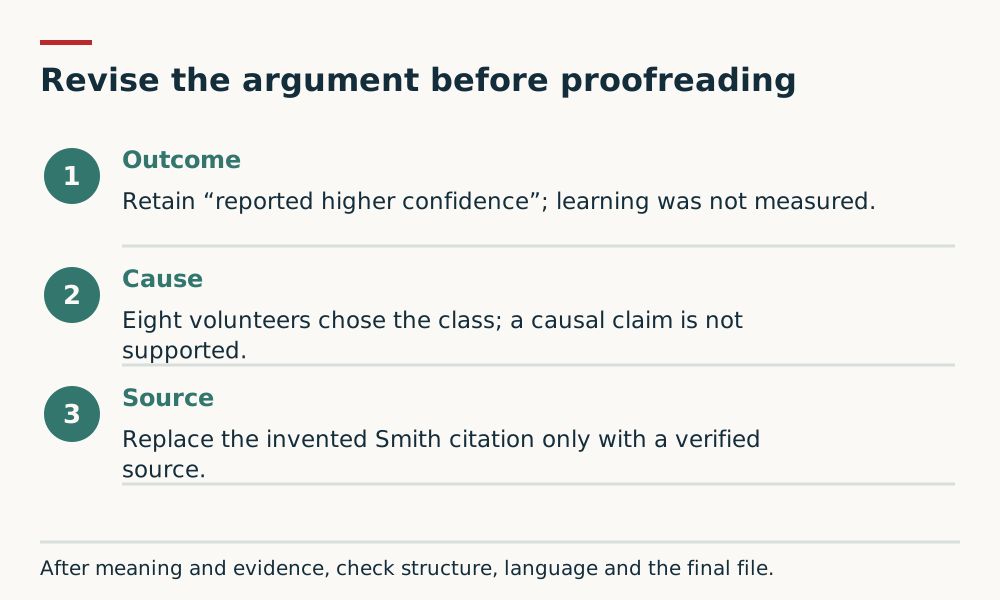
The revision removes the unverified citation and narrows the claim. It also adds a reason for the limitation. In your own assignment, replace unsupported material with evidence you have actually read, or remove the claim. Do not manufacture a source to preserve a sentence you like.
Paraphrase without losing the source or changing the claim
A paraphrase still needs attribution. Purdue OWL’s paraphrasing guidance recommends understanding the passage, drafting in your own words, checking against the original and recording its location. Changing a few words is not enough.
The source note below is invented for this exercise. It is not a real study or a reference to include in an assignment. It lets you practise preserving the population, measurement and limitation without copying a published passage.
Fictional source note, Results paragraph 2: “Of 20 evening-course participants invited to answer a survey, 12 responded. Nine of those respondents said the weekly planner helped them organise study time. The survey did not measure examination performance.”
A misleading version would say: “A weekly planner improved grades for most students.” That substitutes grades for a report about organisation, drops the non-respondents and implies a causal result.
A faithful paraphrase would say: “In the fictional evening-course survey, nine of the 12 respondents felt that a weekly planner supported their study organisation; eight invited participants did not respond, and examination results were not assessed.” In real work, add the required citation to the actual source you read.
Nine of 12 respondents is 75%; nine of all 20 invited participants is 45%. Neither number tells you what the eight non-respondents thought. Keep the denominator with the number. A paraphrasing tool should not choose a stronger claim for you.
| Field | What to retain |
|---|---|
| Source identity | Author, title, date and stable source link or document reference. |
| Exact location | Page, section, table or paragraph that supports the statement. |
| What was observed | Population, measure, result and denominator where relevant. |
| Boundary | What the source does not establish; missing responses or comparison, for example. |
| Your use | Your paraphrase, its role in the argument and the required citation. |
Keep a small revision log
Copy these prompts into your notes. This is a printable worksheet, not an online form; nothing is submitted or stored here. Record the reason for each substantial change so editing becomes something you learn from.
| Location | Problem | Change and reason |
|---|---|---|
| Paragraph or page: ______ | Claim too broad / missing evidence / unclear link: ______ | What I changed and checked: ______ |
| Paragraph or page: ______ | Repeated point / unfamiliar term / grammar: ______ | What I changed and checked: ______ |
Where writing tools fit
Once the reasoning is sound, use the Fog Index as one clarity check. Inspect the sentences behind the number. A lower score is not automatically better when specialist vocabulary is necessary.
Our Grammarly assessment for students includes a dated assistant-run public-checker sample showing the distinction between grammar suggestions and evidence checking. Accept a suggestion only when you can explain why it preserves your meaning.
Follow the rules for your specific assessment before using proofreading or generative features. Keep your drafts and acknowledge assistance when required. If the boundary is unclear, ask your module team before submitting work.
Choose help for the problem you actually have
For an unclear argument, I would start with a reverse outline or a writing-centre discussion. For recurring agreement or punctuation errors, a permitted grammar checker can draw attention to sentences worth checking. For inaccessible instructions or unclear assessment expectations, ask the module team. These routes do different work and are not interchangeable quality scores.
Use the six passes above to locate the bottleneck before buying a writing tool. A clean automated report cannot establish that a citation exists; a shorter sentence cannot repair a conclusion that goes beyond the study.
A useful audit is to count consequential claims you can trace to an examined source. If an invented example draft contains five such claims and only three are supported, its traceability is 3 ÷ 5 = 60%. The next action is to check, narrow or remove the other two. This is a workflow count, not a predicted grade or a validated writing score.
Proofread the finished file in separate passes
After the argument and sources are settled, use the final exported file for the presentation check. I would make one pass for repeated personal errors, another for citations and numbers, and a final pass for headings, tables and page breaks. Separating these jobs makes the checklist easier to use; it does not guarantee an error-free submission.
Read a difficult sentence aloud, or use a permitted read-aloud feature if that helps you notice missing words. Check one sentence at a time when an error keeps slipping past you. Confirm the subject and verb, what each pronoun refers to and whether the punctuation preserves the intended meaning.
Search for unresolved comments and temporary citation markers in the submission copy. For every in-text citation, locate the matching reference entry, then check names, dates and any required page locator against the actual source. Inspect the exported document again after the last edit; a correct working file does not establish that the uploaded version is the same.
The final check before submission
- Read the title, introduction and conclusion together: do they answer the same question?
- Check every quotation, statistic and citation against its source.
- Confirm that each table or figure is explained and labelled.
- Remove editing comments and unresolved placeholders from the submission copy.
- Open the final exported file and check pages, references and word count.
Sources and further reading
- George Mason University Writing Center: editing checklist (accessed 12 October 2026)
- Abertay University: Grammarly and assessment-specific rules (accessed 12 October 2026)
- Purdue OWL: Paraphrase: Write It in Your Own Words (accessed 12 October 2026)
Access dates are recorded beside each source. Please report a source or factual concern.