Digital learning
Grammarly for students: useful corrections, with limits
For most students, my starting recommendation is permitted free proofreading plus a manual evidence check. Grammarly can help expose language errors, but the retained public-checker sample does not establish that it validates reasoning or references. Consider Pro only when a permitted feature solves a repeated need that free or institutional access does not cover.

Key takeaways
- The retained screenshot shows two suggestions on one synthetic paragraph.
- The underlined words are “have” and “proves”.
- No visible warning in that capture addresses the causal or citation claims.
- Compare free and institutional access before paying for Pro.
What was actually checked
I recommend starting with permitted free or institutional access. The documented sample on this page is a separate assistant-run, logged-out public-checker test from 18 September 2026. One original synthetic paragraph was submitted; the retained screenshot shows two suggestions, with no correction accepted. It does not document my personal test or assess the paid editor, extension, plagiarism checker or AI detector. Plan and billing information was rechecked on 28 September.
The small sample illustrates a workflow boundary. It cannot establish an overall accuracy rate, compare every competing tool or tell you how Grammarly handles a full dissertation. Prices and plan features below were checked separately against official documentation.
The exact sample and observed result
Actual output from the original sample
Swipe across the screenshot to inspect the detail, or open the full-size version below.
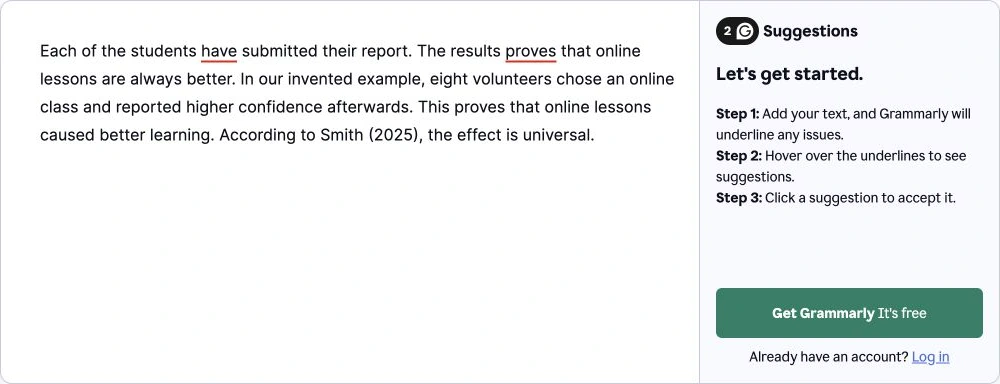
Visible annotation: “have” in “Each of the students have” and “proves” in “The results proves” are underlined. The screenshot does not show an evidence-quality warning for the causal, confidence or citation claims. This limited result is not a test of all Grammarly features.
Test text: “Each of the students have submitted their report. The results proves that online lessons are always better. In our invented example, eight volunteers chose an online class and reported higher confidence afterwards. This proves that online lessons caused better learning. According to Smith (2025), the effect is universal.”
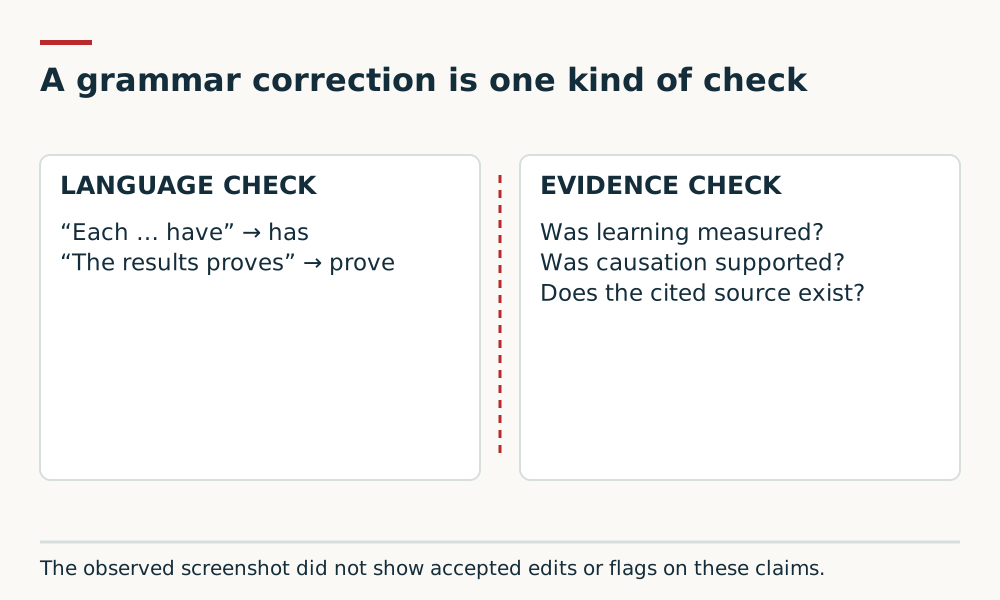
All people, results and the Smith citation in the paragraph are invented test material. The retained screenshot displays two suggestions and underlines “have” and “proves”. It does not show an accepted edit or a visible warning on the causal, confidence or citation claims. The grammatically appropriate revisions are “has” and “prove”; that explanation is editorial analysis of the sentence.
| Item | Observation | What the student still needs to do |
|---|---|---|
| “Each … have” | “have” underlined; no accepted correction shown in this capture. | Understand that “each” takes a singular verb here. |
| “The results proves” | “proves” visibly underlined. | Check agreement: the plural “results” takes “prove”. |
| Confidence treated as learning and causation | No visible flag on those claims in this run. | Inspect what was measured and whether the design supports causation. |
| Smith (2025) and “universal” | No visible flag on the invented citation or universal claim in this run. | Locate a real source and check the scope of its evidence. |
My judgement from the sample
The screenshot supports a narrow but useful observation: two grammar problems became visible. It also shows why a proofreading pass is not an evidence review. Correcting both verbs would still leave unsupported causation and an invented citation. I would use this assistance after checking the argument, then review every suggestion for meaning.
The student editing checklist shows a manual revision of the weak argument. Compare that revision with a simple verb correction: it changes the claim, explains its limits and removes an unverified reference.
Free, Pro or regional Plus for a student?
Grammarly’s plan page lists basic grammar and spelling help on Free, alongside AI features. Pro adds more rewriting and style assistance. Those extra features may be unnecessary, or unsuitable for a particular assessed task. A paid plan is not evidence that a suggestion is correct or that its use is permitted.
Official support listed US$30 per month, US$60 per three months and US$144 per year on 28 September 2026. The US$12 monthly equivalent is a US$144 annual bill for one member. These are US-dollar support-page rates; regional prices, taxes and eligibility require your checkout. Check institutional access before buying.
Grammarly also documents a regional Plus plan in selected countries. Eligibility depends on both billing country and payment details; existing paid-plan holders cannot simply switch into it immediately. Plus is not compatible with special offers or discounts. Do not assume that a student discount applies, or that the Pro totals below quote your Plus price. Check the plan name, full charge and renewal terms shown to you, then compare them with any university access.
| Your situation | My starting recommendation |
|---|---|
| Occasional proofreading, rules permit it | Try the free help and a manual checklist. |
| Your university already provides access | Check the included features and university guidance before purchasing separately. |
| Repeated permitted editing needs beyond the free features | Test those exact needs before choosing a paid billing period. |
| Assessment prohibits the relevant AI or rewriting assistance | Do not use those features for that task, regardless of plan. |
Grammarly, Microsoft Editor or a writing adviser?
Microsoft’s Editor documentation describes basic spelling and grammar checking with a free Microsoft account, with additional refinements available through Microsoft 365. For a student already writing in Word, I would try the included help before buying a second service. Feature availability depends on the app and account.
Grammarly Free is a sensible alternative when its permitted workflow suits where you write. Pro deserves consideration only for a specific additional need. We have not run the same paragraph through both products under equivalent settings, so this review does not declare either more accurate.
For a weak thesis, uncertain source or paragraph that does not answer the assignment, a writing adviser or the manual checklist is the better route. My winner for avoiding an unnecessary purchase is the permitted tool you already have; my choice for argument-level feedback is qualified human support rather than a grammar score.
What does a term of paid use actually cost?
These examples assume uninterrupted paid access, no refund for unused time, and one billing pattern throughout. Quarterly billing buys whole three-month blocks; annual billing buys twelve months upfront. Mixed billing changes, pauses, offers, trials and local checkout rates are outside this simple comparison.
For a three-month writing project, I would compare the US$60 quarterly charge with US$90 in monthly payments before considering an annual plan. For five months, two quarterly blocks cost US$120, less than the US$144 annual charge. For nine months of genuinely needed paid access, annual billing is lower than either uninterrupted alternative. Neither calculation is a reason to pay if the free features or your institution’s access already meet the task.
| Planned consecutive paid access | Monthly at US$30 | Quarterly at US$60 per block | Annual upfront |
|---|---|---|---|
| 1 month | US$30 | US$60 for 3 months | US$144 for 12 months |
| 3 months | US$90 | US$60 | US$144 |
| 5 months | US$150 | US$120 for 6 months | US$144 |
| 9 months | US$270 | US$180 | US$144 |
Check access through your institution first
- Search your institution’s software or library portal for current provision.
- Confirm your eligibility and the exact included features with its IT or library team.
- Read the assessment rules independently of the licence; access does not make every feature permitted.
Keep control of the writing
Abertay University’s guidance is one concrete example: it gives the assessment brief priority and advises disabling generative features for proofreading. Your own institution may set different boundaries. Product names such as Free or Pro do not settle what is permitted.
Save the original draft. Review each suggestion individually, especially changes to certainty, technical terms and the relationship between ideas. Do not submit confidential material to a third-party tool without the appropriate permission. For readability alone, the Fog calculator on this site provides a narrower check.
Who I would recommend it to
I would consider Grammarly for a student who can use it within the assessment rules, wants help noticing language errors and will review rather than automatically accept suggestions. I would not buy it simply to make an essay look finished: a writing-centre appointment, careful source checking and a revision log may address the real problem more directly.
Setup, learner access and privacy checks
Check that the exact editor, browser or writing application you use is supported and that the relevant feature is permitted for the assessment. The logged-out public-checker sample does not test every extension, integration or paid feature.
Review what text the tool processes and your institution’s confidentiality rules before uploading work. This review does not establish child suitability, parental controls or assistive-technology compatibility; a named feature or plan alone is insufficient.
These are material checks before purchase, not features independently verified by this update. Existing captures and product-source checks retain their stated dates; this editorial update adds suitability and evidence limits. If a required condition cannot be confirmed, choose a different resource or resolve it before paying.
Sources and further reading
- Grammarly public checker: retained assistant-run capture from 18 September 2026 (accessed 18 September 2026)
- Grammarly: Free and Pro plan features (accessed 28 September 2026)
- Grammarly Support: Pro prices and regional billing (accessed 28 September 2026)
- Abertay University: Grammarly guidance (accessed 23 September 2026)
- Microsoft Support: Editor account, app and subscription features (accessed 23 September 2026)
- Grammarly Support: regional Plus eligibility, billing and discount restrictions (accessed 28 September 2026)
Access dates are recorded beside each source. Please report a source or factual concern.