Learn better
How to remember what you read: a practical method
Choose what you want to get from a text, read a manageable section, close it and reconstruct the useful ideas. Check your attempt against the source, correct errors and return to the questions later. The goal is usable understanding, not remembering every sentence.

Key takeaways
- Give each reading session a question to answer.
- Try recall before reopening the text.
- Check qualifiers and reasoning as well as facts.
- Revisit important ideas after a gap and use them in a new example.
Start with a reading goal
For a practical book, ask what decision or action the chapter should improve. For a course reading, turn the learning outcome into a question. For an argument, identify the conclusion and the evidence needed to support it. Reading for pleasure does not need to become a test; use this method for ideas you want to retain.
Choose a stopping point that contains a complete idea: a short subsection, one worked example or a few paragraphs. If you cannot explain it, first check vocabulary and background knowledge. A memory routine cannot repair a passage you have not understood.
Try this original practice passage
The following invented example is a reading exercise, not a report of a real trial.
A community workshop compares two ways to teach a bicycle puncture repair. One group watches a demonstration once. Another watches the same demonstration and then practises with a spare inner tube. Both groups later repair a puncture without help. The practice group completes more of the steps correctly. However, it also spent twice as long on the activity. The comparison therefore cannot tell us whether the difference came from practice, extra time or both. A better follow-up would give both groups the same total learning time and record which steps each person can perform independently.
Read the passage once, then look away or cover it. In your own words, write the main comparison, the result and the reason to be cautious. Do this before reading the example attempt below.
An imperfect recall attempt
Example attempt: “People learn repairs better by practising than by watching. The workshop proved this because the practice group repaired more punctures.”
This remembers the broad topic but overstates the conclusion and changes the measured outcome. The passage says more steps were completed correctly, not more punctures repaired. It also says time differed between the groups. A familiar-sounding summary can conceal both errors.
| Question | Checked answer | Why it matters |
|---|---|---|
| What was measured? | Steps performed correctly in an unaided repair. | Keeps the outcome precise. |
| Why does extra learning time matter? | It is another possible explanation for the group difference. | Preserves the limit on the causal claim. |
| How could you improve a comparison of two study methods? | Equalise total learning time and choose an independent performance task. | Applies the reasoning beyond bicycle repair. |
Correct the idea, then retrieve it again
A more accurate recall is: “The demonstration-plus-practice group performed more repair steps correctly, but it also had more learning time. We cannot separate the effects of practice and time from this comparison.” Close the passage again and explain why that qualification changes the conclusion.
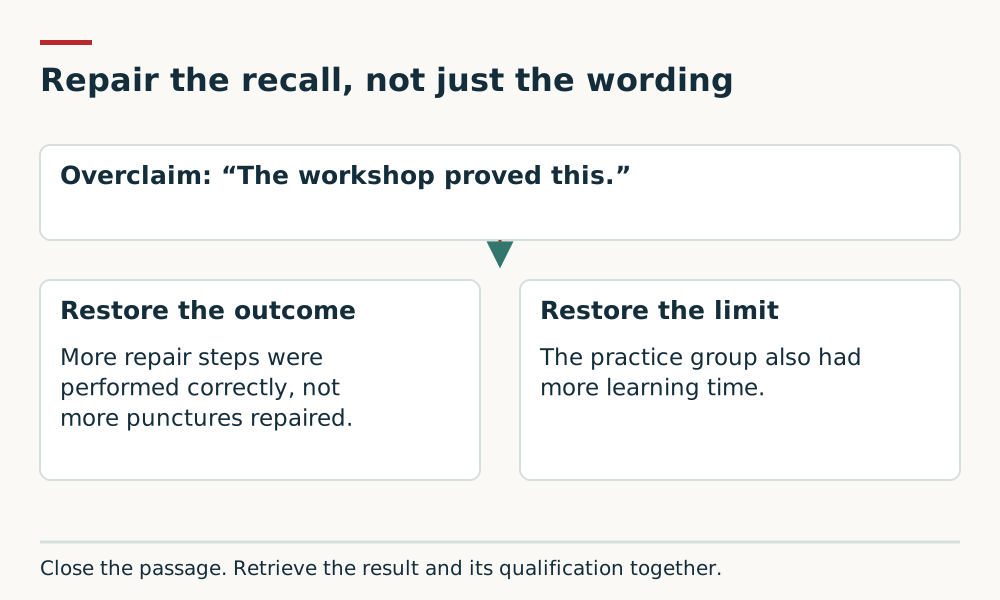
Do not copy the whole paragraph into your notes. Keep a short correction beside your original answer and write a question that targets the error: “Which other difference could explain the result?” Then try a new example, such as two classes with different amounts of homework. This tests whether the reasoning is usable beyond the original wording.
If your next task is organising a chapter for an assignment, use the textbook note-taking example to keep your ideas and source locations together.
What a useful recall check should preserve
In the imperfect bicycle-repair answer above, the learner kept the topic but changed the measured outcome and removed the time difference. I would treat that as incomplete understanding even if the summary sounded fluent. The corrected answer preserves three things: the comparison, the observed repair steps and the competing explanation.
Use a short summary when you need the central argument; use a question-and-answer note when you need to retrieve a fact; use a worked problem when the goal is performing a procedure. My default for this passage is an explanation plus one new application, because remembering the phrase “practice is better” misses its central qualification.
Record whether each of the three elements is accurate before looking back. Do not turn this small teaching check into a general retention percentage. The passage is invented, and no learner study of this worksheet has been conducted.
A flexible revisit schedule
Try a brief closed-text check the next day, a few days later and about a week later. These intervals are a practical starting point, not a universally optimal schedule. If you miss the main idea, shorten the next gap and reread the relevant section. If recall is easy and accurate, lengthen the gap or attempt a more demanding application.
At each revisit, answer first and check second. Mix an older question into a later reading session. You can speak your answer, sketch a relationship or solve a problem; the useful feature is producing an answer before seeing it. Keep page numbers or section names so corrections are easy to trace.
A reusable reading and review worksheet
Copy this structure into a notebook or print this page. Use a separate row or sheet for each important idea. The prompts below are intentionally blank for your own reading; they are not a form and nothing is submitted or saved by this site.
| Prompt | Your record |
|---|---|
| Text, author and page or section | ________________________________ |
| Reading goal or question | ________________________________ |
| My closed-text explanation | ________________________________ ________________________________ |
| Evidence or example supporting the idea | ________________________________ |
| What I missed, changed or overstated | ________________________________ |
| Corrected answer and source location | ________________________________ ________________________________ |
| A new situation where I could use this | ________________________________ |
| Next review date and result | ________________________________ |
Why use recall and spacing?
In Roediger and Karpicke’s 2006 prose-reading experiments, students who retrieved material performed better on delayed tests than those who repeatedly studied it, although repeated studying did better on the immediate test. That supports testing what you can produce after a gap rather than trusting immediate familiarity. It does not establish one exact schedule for every reader.
The Dunlosky and colleagues review compares practice testing, distributed practice and other study techniques across different conditions. Our broad memory guide discusses the evidence and limits; this page applies the ideas to a reading task. The worksheet and bicycle example are original teaching devices, not a separately validated intervention.
When the method needs adapting
Technical procedures need practice with the procedure. A poem may require exact wording; an essay usually requires accurate ideas and evidence. Dense unfamiliar material may need vocabulary work, smaller sections and a teacher’s explanation before recall is useful.
Keep highlighting selective: mark what helps you return to a passage, then check whether you can explain it without looking. If you repeatedly remember an inaccurate summary, improve the correction and consult another reliable explanation. More repetition is not enough when the underlying understanding is wrong.
Sources and further reading
- Roediger and Karpicke (2006), Test-enhanced learning (accessed 23 September 2026)
- Dunlosky et al. (2013), Improving Students’ Learning With Effective Learning Techniques (accessed 23 September 2026)
- EEF (2021), Cognitive science approaches in the classroom: evidence and implementation limits (accessed 23 September 2026)
Access dates are recorded beside each source. Please report a source or factual concern.