Digital learning
Are Coursera certificates worth it? What they prove
A Coursera certificate can be useful when it records relevant learning and you can demonstrate what you learned. Its value depends on the particular award, assessment and intended use. Completing a short course is different from earning a university degree, receiving transferable credit or passing an external professional certification exam.

Key takeaways
- Check who issues the award and what assessment you must pass.
- A provider’s reputation does not give every short course accredited status.
- Ask the receiving employer or institution about its actual requirements.
- Pair the certificate with an accurate explanation and work you can discuss.
Five things a learning credential can mean
This comparison uses public provider and awarding-body information reviewed on 5 October 2026. It distinguishes kinds of evidence rather than ranking unlike qualifications. No programme completion test or employer-response study was performed for this review.
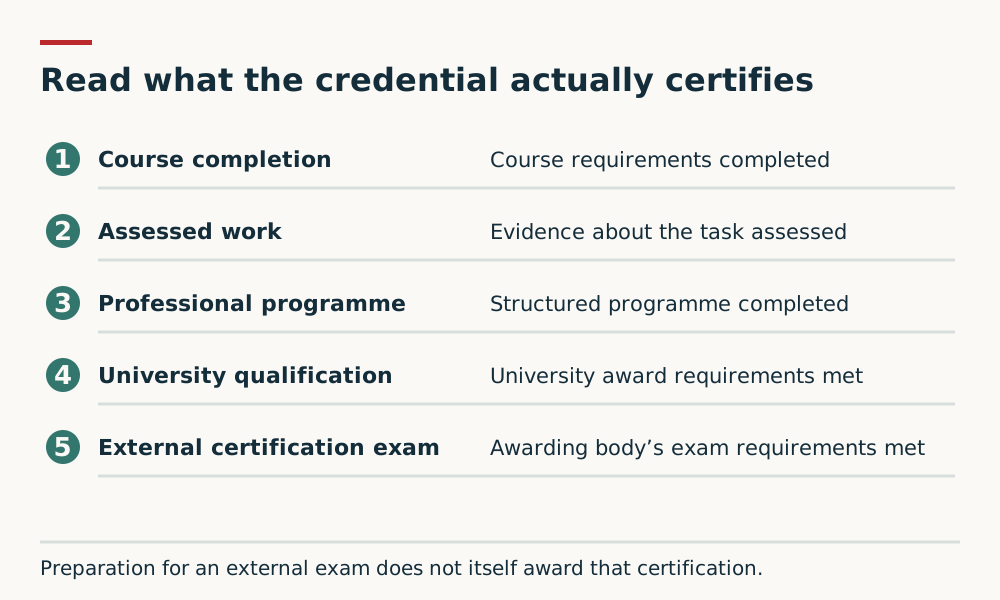
| Type | Verified example or check | What it supports | What it does not establish |
|---|---|---|---|
| Course completion | Learning How to Learn, from Deep Teaching Solutions on Coursera | Completion of the course requirements for its shareable certificate | A degree or independent mastery of every claim in the course |
| Assessed work | Learning How to Learn lists assignments and a final teaching project | Evidence about the task actually assessed; inspect the rubric and feedback | Performance on unfamiliar tasks or under workplace conditions |
| Professional programme | Google IT Support Professional Certificate | Completion of a structured programme of IT-support learning | Automatic employment, licensure or a separate exam-based certification |
| University qualification | University of London BSc Computer Science | A degree awarded under the university’s own requirements | A degree purchased through a general Plus subscription |
| External certification exam | Microsoft Certified: Azure Fundamentals (exam AZ-900) | Certification only after meeting that body’s requirements | That a related Coursera preparation course itself awards the external certification |
Read specific course and programme pages
Check the inclusion badge on the exact course
Swipe across the screenshot to inspect the detail, or open the full-size version below.
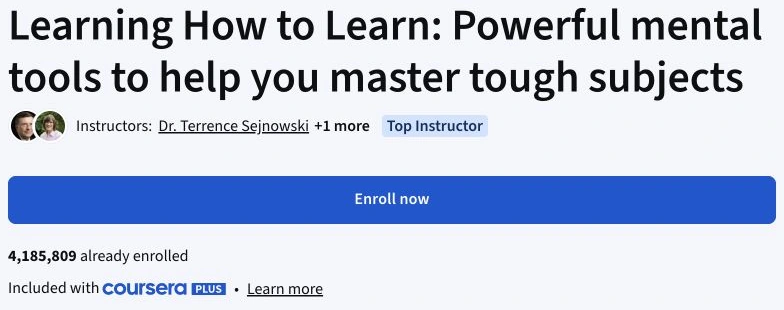
Learning How to Learn displays “Included with Coursera Plus”. Recheck the specific course before paying. A course listing or completion certificate does not by itself establish academic credit.
The Learning How to Learn listing identifies Deep Teaching Solutions, a shareable certificate, 11 assignments and two peer reviews, including a final project about teaching others. Those facts describe the learning and assessment offered; they do not make the certificate a university qualification.
The Google IT Support programme page describes a six-course Professional Certificate and an estimated three months at ten hours per week. Its current page presents inconsistent credit figures in different sections, so do not plan a transfer from either figure. Confirm the current ACE recommendation and obtain written acceptance from the receiving institution before using a credit claim in a study plan.
The University of London’s BSc Computer Science page describes a separate university programme with admissions, modules, assessment and fees. Its qualification status comes from the university’s award requirements. Coursera Plus excludes degrees; buying Plus is not enrolment in that BSc.
Credit, accreditation and acceptance are separate questions
Coursera’s terms say its content does not carry academic credit unless a credit-granting institution explicitly provides it. Even when one institution recognises learning, another need not accept it. Ask for written confirmation from the institution that will receive your application, including the exact award, completion dates and any conditions.
Microsoft’s Azure Fundamentals page specifies a proctored exam. Completing a preparation course alone is not the same award. For professional certification, check the awarding body’s own assessment, identity and renewal requirements. A preparation course and a certification exam can be different purchases. For employer recognition, compare the certificate’s actual skills with a job description and ask the employer where the answer matters. A logo, testimonial or provider employment survey does not prove universal acceptance.
When paying for a certificate may make sense
| Your purpose | Useful next step | When to reconsider payment |
|---|---|---|
| Explore an unfamiliar subject | Try accessible samples, OpenLearn or a library resource | You mainly want to find out whether the subject interests you |
| Build a practical skill | Inspect assignments and plan a project you can explain | The course offers little practice or relevant feedback |
| Document professional development | Ask your employer which records and providers it accepts | Your organisation already provides access |
| Apply for a role | Match the learning to specific requirements and show relevant work | You expect the certificate alone to secure an interview |
| Earn credit or meet a regulated requirement | Confirm the precise award with the receiving institution or regulator | Only general marketing language supports the claim |
Two learners, two different recommendations
A career changer trying to understand entry-level IT support may find the Google programme a useful structured introduction, provided they practise troubleshooting independently. A learner who must meet a degree requirement should start with the relevant university award instead. The professional certificate and degree are not interchangeable just because both can involve Coursera.
The Google IT Support listing showed six courses and an estimate of three months at ten hours per week when checked on 5 October 2026. Those are provider planning figures, not independently measured completion time or job-readiness results.
My recommendation is to pay for a credential only when its specific assessment or acceptance adds value to your goal. If you mainly want to explore the subject, free learning can win. If an employer or institution requires a particular award, its written requirements decide the choice; a popularity figure or testimonial cannot settle it.
A checklist before you enrol
- Issuer: who awards the credential, and how can someone verify it?
- Assessment: are there quizzes, projects, reviewed work or a supervised exam?
- Identity: what verification applies to the actual award?
- Credit: which institution accepts it, for what programme and on what conditions?
- Relevance: which requirement or skill gap does it address?
- Total cost: include expected paid months and any separate exam or assessment charges.
- Evidence: what original work can you retain and share under the course rules?
- Access: check existing employer, university or library provision before paying.
Describe it truthfully on a CV
A hypothetical entry after real completion could read: “Learning How to Learn, Deep Teaching Solutions via Coursera, completed [month and year]. Applied retrieval practice and spaced review in a personal study plan.” Replace the date with your actual completion date and include the application only if you did it. Link the verifiable credential when available.
Put a short course under professional development or additional learning. Do not describe yourself as a graduate of a university merely because its name appears on a platform course. For an assessed project, state what you personally produced, the tools used and the limits of the work. A concrete explanation is easier to evaluate than an unsupported claim of expertise.
Separate certificate value from subscription value
Learning How to Learn showed Plus inclusion when checked. If that course and other intended offerings remain eligible, compare the study-time and cost of Coursera Plus with the actual individual payment options. That calculation covers access costs; it does not settle the value of the award to your employer or institution.
For a degree or an excluded programme, use its own admissions and payment information. Do not assume a general subscription covers it. A free learning resource can be the better choice when the skill matters and a paid credential adds little to your purpose.
Sources and further reading
- Coursera: Learning How to Learn course and assessment outline (accessed 5 October 2026)
- Coursera: Google IT Support Professional Certificate (accessed 5 October 2026)
- University of London: BSc Computer Science (accessed 5 October 2026)
- Microsoft Learn: Azure Fundamentals certification and exam requirements (accessed 5 October 2026)
- Coursera Terms of Use: academic credit and programme limits (accessed 5 October 2026)
- Coursera Plus: inclusion and degree exclusions (accessed 5 October 2026)
Access dates are recorded beside each source. Please report a source or factual concern.