Digital learning
DataCamp for beginners: can you use the skill without the prompt?
For a beginner who wants a guided sequence of coding tasks across data subjects, DataCamp is worth inspecting. For learning basic SQL alone at no cost, I would start with SQLBolt and an independent query task. In either case, the deciding check is whether you can explain a new result without relying on a lesson prompt.

Key takeaways
- Start with the free access and a specific skill goal.
- Check the current lesson format instead of assuming an older review still describes it.
- Use a small independent task to check transfer.
- A course completion record and job readiness are different claims.
What this review checks
This is an editorial assessment of DataCamp’s public pricing and Introduction to SQL outline, reviewed on 5 October 2026. The assistant reran the original exercise in an in-memory SQLite 3.51.0 database using the four synthetic rows below. It was not run inside DataCamp, and neither this check nor the public outline establishes my personal use, paid-course completion or current AI-tutor performance.
That distinction matters because course formats can change. A familiar brand is not enough to establish how the current lessons, feedback or assessment behave. I would use the available sample to check those features before committing to a longer plan.
What the public SQL outline reveals
The public Introduction to SQL outline introduces database tables, selecting values and query results. Before subscribing, inspect the current sample and feedback in the format available to your account. Treat provider duration estimates as planning information; none is an independently measured completion time for this review.
These are suitable concepts for a first independent check. The public description supports inspecting the course for an introduction; it does not establish that a beginner will become a capable analyst after one short course. Leave room for repetition, mistakes and work on unfamiliar data.
An original task to try without a lesson prompt
The invented table below records learning sessions. Each row is one session, not one unique learner. Task: return the distinct learner names, labelled “learner_name”. Predict the result before looking at the solution. This checks whether you understand what DISTINCT removes.
| learner | topic | minutes |
|---|---|---|
| Amina | SQL | 20 |
| Ben | SQL | 15 |
| Amina | Reading | 30 |
| Chen | SQL | 25 |
The checked solution and why it works
Query: SELECT DISTINCT learner AS learner_name FROM study_sessions ORDER BY learner_name;
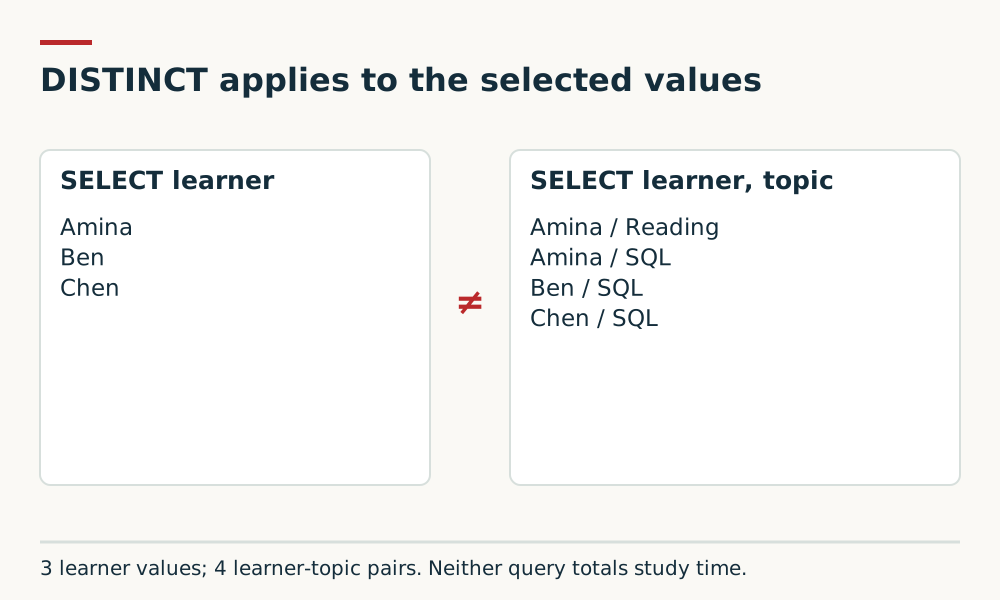
Verified output: Amina, Ben, Chen under the heading learner_name. The assistant executed this query on 23 September 2026 against the four synthetic rows in SQLite 3.51.0. Amina appears once because DISTINCT applies to the selected learner values. ORDER BY makes the order explicit. This verifies the example’s answer, not DataCamp’s teaching.
Now change the query to SELECT DISTINCT learner, topic FROM study_sessions ORDER BY learner, topic; and predict the result. It returns four rows: Amina/Reading, Amina/SQL, Ben/SQL and Chen/SQL. DISTINCT now evaluates the pair of selected values. Both Amina rows remain because their topics differ. That result was also checked in SQLite.
Finally, explain why neither query answers “Who studied the longest?” You would need to sum session minutes per learner for that question. Recognising what a query does not answer is part of understanding it.
For the longest total study time, SELECT learner, SUM(minutes) AS total_minutes FROM study_sessions GROUP BY learner ORDER BY total_minutes DESC, learner; returns Amina 50, Chen 25 and Ben 15. The assistant verified these totals in the same run. They are invented dataset values, not measured study behaviour.
My practice routine for a beginner
Keep a short error log: expected result, actual result, cause and correction. If you can only finish with a provided hint or AI-generated answer, count that as supported practice. Repeat a smaller problem until you can explain your own solution. This is a recommended routine, not a measured DataCamp outcome.
- Complete a small lesson and write down the problem it solves.
- Close the lesson and rebuild one example from a blank query.
- Change a name, add a duplicate or alter a value, then predict the result.
- Compare the actual result with the prediction and explain any mismatch.
- Return after a gap and try a similar task with different data.
DataCamp versus SQLBolt for beginner SQL
SQLBolt offers interactive SQL lessons and exercises in the browser. Its public sequence covers querying, filtering, joins and aggregation. For learning those basics before deciding whether to pay, it is my starting choice.
DataCamp is the broader option if you want a selected sequence across data subjects and value the guided course format after inspecting a sample. Its full course access can carry a recurring subscription cost. SQLBolt is a narrower resource; finishing its exercises is not equivalent to completing a wider data-analysis programme.
Use the same independent task to compare them: query unfamiliar rows, predict the result and explain why duplicate names appear once or twice. I would choose SQLBolt for a no-cost SQL introduction, and consider DataCamp when a specific broader track fills a demonstrated gap. No comparative accuracy, completion or employment benchmark was collected.
What to check before paying
The $28 monthly equivalent and $336 annual charge recorded from a US-facing public display on 28 September 2026 are a dated example, not a current universal quotation. When checked on 5 October, the public pricing page rendered a different currency and an introductory first-month offer for the checking region. Verify the full charge, renewal amount, currency, tax and eligibility at your own checkout instead of carrying either display into a budget. Basic access still offers the first chapter of each course, while paid access covers the broader catalogue.
Compare the full charge with one defined learning sequence and the hours you can protect. Do not count every item in a catalogue as value you will receive. Check existing university or employer access and record the cancellation route and next billing date.
| Need | Starting point |
|---|---|
| Unsure whether coding suits you | Try the available free material and this small task. |
| Want repeated guided practice in a defined skill | Inspect the relevant sequence and its sample exercises. |
| Need to analyse a real dataset independently | Add an open-ended project and outside feedback. |
| Need a recognised qualification or a job requirement | Check the exact credential and receiving organisation’s requirements. |
My recommendation
I would consider DataCamp when its current format helps you start and sustain practice. I would pair it with independent tasks such as the one above. If your next step is a portfolio project, give the project its own time and feedback plan; finishing guided exercises alone does not establish job readiness.
Setup, learner access and privacy checks
The beginner practice format is a starting point to assess against your existing knowledge and goal. The independent SQL exercise below demonstrates an original task outside DataCamp; it does not measure the product’s setup or accessibility.
Try the available introductory material on your intended device and check browser requirements, keyboard interaction, explanations and the support you need. This assessment does not establish child suitability, assistive-technology compatibility or a privacy audit of learning records.
These are material checks before purchase, not features independently verified by this update. Existing captures and product-source checks retain their stated dates; this editorial update adds suitability and evidence limits. If a required condition cannot be confirmed, choose a different resource or resolve it before paying.
Sources and further reading
- DataCamp: current Introduction to SQL course outline (accessed 5 October 2026)
- DataCamp: free access, pricing and billing information (accessed 5 October 2026)
- SQLite: SELECT, DISTINCT and result ordering (accessed 23 September 2026)
- SQLBolt: public interactive SQL lesson sequence (accessed 23 September 2026)
Access dates are recorded beside each source. Please report a source or factual concern.